

Reference from Emily Madly‘s Dropbox folder of fat models, which I’m very grateful for. (Emily tweets the link whenever they add more photographs, so I recommend following their twitter account.)
Reference from Emily Madly‘s Dropbox folder of fat models, which I’m very grateful for. (Emily tweets the link whenever they add more photographs, so I recommend following their twitter account.)

Working on figure studies. I thought about using a little artist mannequin figure, and though I know the point is to get into your head a structure rather than accurate body shape, the problem with all artist mannequins right now is that they aren’t great at communicating the actual weight of a human being. I rather suspect that taking the artist mannequin too literally unfortunately helps to create the anti-fat nature of most visual art. The lack of larger models also contributes, as well as society’s general anti-fat bigotry that seeps into the artistic consciousness.
I’m myself fat. It was a difficult to road to get to a point where I loved myself. It’s helped along by my own manifestation of dysphoria, weirdly enough; when I’m fat, my dysphoria is much, much less.
As I started to work on figure studies of fat models, I realized that all the lessons given for thin models applies. In particular, no matter how thin or fat a model is, the idea is to render the muscle and fatty tissues, not just the skeletal frame. Every fold matters, just as marking out the landmarks of the human body matters: things like collarbone, kneecap, elbow joints, wrists. Make use of overlaps to communicate the form of the body; if you can get overlaps right, you can even get away without shading, although shading is a good exercise in and of itself.
Most importantly: love the shape and form and weight and contour and life and spirit of your model. If you can’t do that, this can hinder your art. Learning to discard the hatred that society breeds in us towards fat folks is valuable, because being more human and caring, and thus aware, is valuable.
I think, for an artist, learning to draw fat people is the quickest and most thorough way to this end.
I still get my proportions wrong, but for me it’s that I work based on proportional measurement and contour, rather than form-building and roughing-in, and I need to get better at proportions and contour. I’m also used to thinner models, so this mindset is something I’m working to get out of.
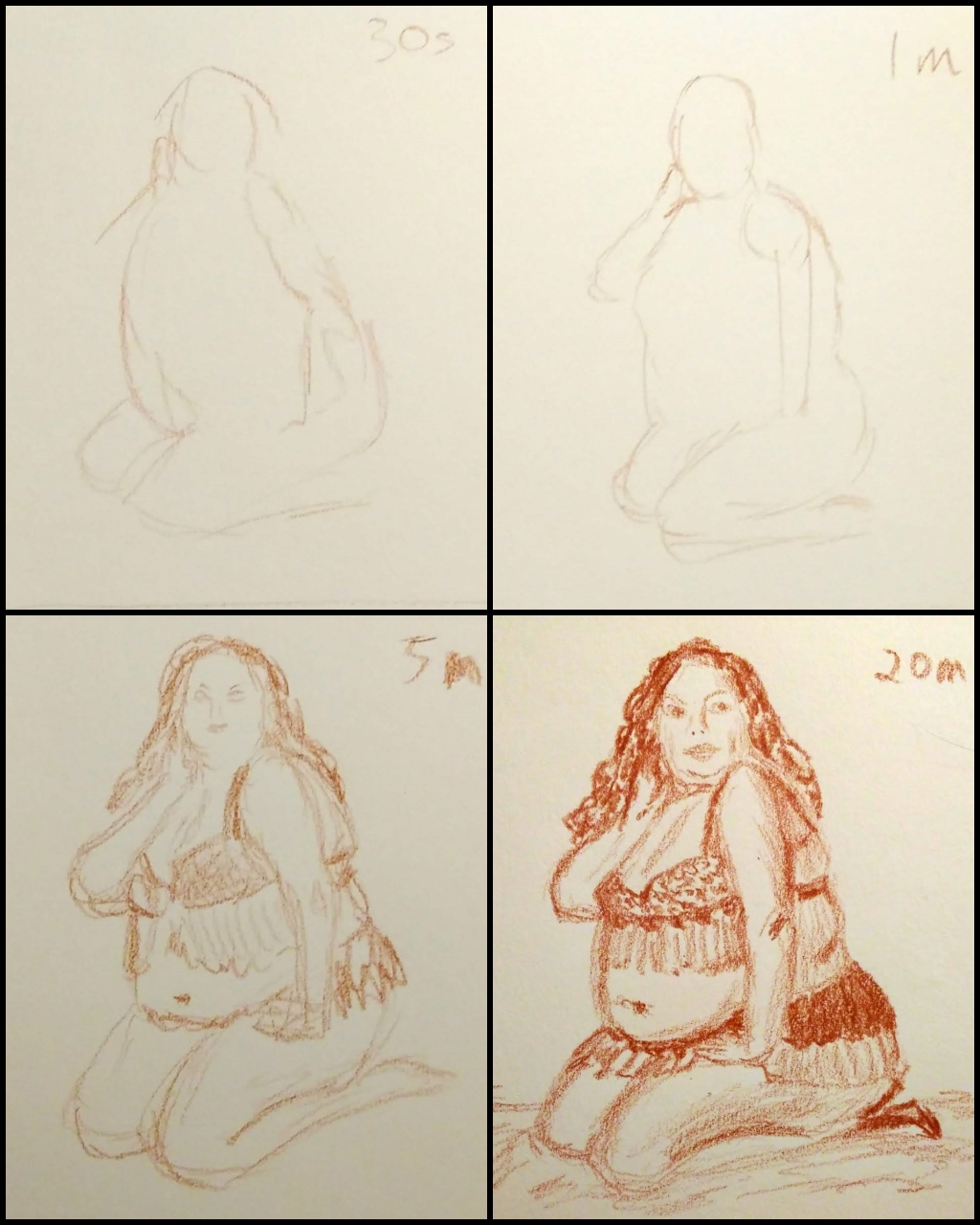
I’m really enjoying myself. I took a slower, alternative approach to the typical live model class; instead of switching model poses between different time lengths (so for instance, you have 5 poses for 30-second sketches, and 5 more different poses for 1-minute sketches, etc), I just used one pose and changed the time length between 30 seconds, 1 minute, 5 minutes, and 20 minutes. This method helps me get my bearings in a less stressful way while still preserving the lesson of learning to capture the essence of a pose in under a minute.
By the by, materials used: oil-grease-impregnated sanguine 5.6mm lead, which means a dustless application (helpful for asthma). I actually used the dull, unsharpened end for most of the work, and a sharpened end for the finer details in the 20-minute pose. A blunt and blocky drawing instrument helps dampen down the desire to work in detail too early.
The model here is Keira Leilani, source is from Croquis Cafe. I really love Keira Leilani’s expression, poise, and grace. That’s really nice lingerie too, and Keira wears it well.


You must be logged in to post a comment.